
The Building for Bharat movement, a rising phenomenon, reaches for identity under the garb of thought leadership. However, identity is inconsequential to building good products.
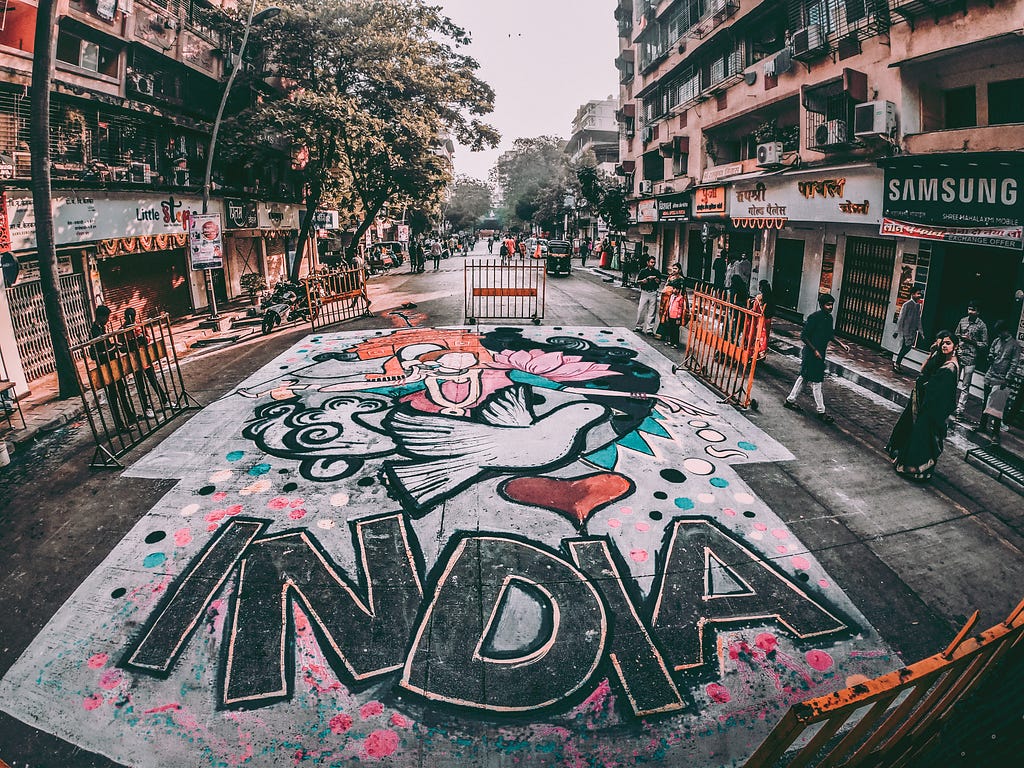
Much has been written and spoken, in the startup circles, about this idea of building products for Bharat. Bharat is supposed to represent what makes the weighty-middle part of the Indian demographic pyramid. This mostly consists of the aspirational middle-class people, those who are more likely to be found in places like Coimbatore or Berhampur, coming online for the first time mostly thanks to the ubiquity of cheaper data plans and lowering cost of smart phones. But in many ways, they are also supposed to be those who don’t fit into the existing idea of India.
By separating out the people of Bharat from India, the perpetrators of this meme want us to believe that the definition of India is innately incomplete and offers no place for people who don’t check off some criteria. And that the so-far invisible people of Bharat live in a sequestered world, far away from the one inhabited by those in India — so distant is their world that we need a new country to describe their address.
Having lived and grown in a different world, the people of Bharat, their newly appointed representatives claim, differ from the Indians in their aspirations, their problems, and the solutions that would work for them. And so we can’t use our existing mental models that were developed for India, to be applied for the audiences of Bharat.
Us v/s Them
An important aspect of the idea of existence of Bharat is that it doesn’t really stand on its own accord but has instead been constructed in contrast to the idea of India. It’s then essential to ask, whose idea of India are we talking about here?
If Bharat is supposed to represent the more economically challenged, lesser technology savvy, not-urban, non-English speaking audiences, then it becomes clear that India is supposed to be the opposite of all of those things, i.e. economically well off, more tech savvy, largely urban and English speaking. In short, the “Urban Elites”. To characterize all Indians who don’t fit into some arbitrarily made-up parameters, into caricature-like versions of themselves, is plain intellectual dishonesty.
Perhaps I should establish my own Bharat bona-fide at this juncture. For the record, I’m very supportive of Indian tech companies that innovate and build products keeping the realities of Indian users in mind. I also think that companies that blindly ape the products developed in Silicon Valley or other markets rightly deserve the criticism they receive, and that we can’t apply the monetization and distribution models suited for one segment to populations at large.
But after hearing out the arguments and concerns of the representatives of Bharat, I’m convinced that this isn’t very far from Silicon Valley’s classic ‘we will change the world’ soapbox monologue.
Facts v/s Narratives
Consider the following situations:
- A single mother in a small town searches the web for a suitable savings product
- A proprietor of a transport business in Vijayawada applies for a working capital loan.
- A young woman searches online for a good OB-GYN nearby
- A security guard tries to book bus tickets for his father online
These are a minor selection of instances of situations that are played out millions of times across the country every day. Now think of what would help us come up with the best ways to help these individuals achieve whatever they are looking for. Would knowing whether they belong to Bharat help? The answer is obviously no.
In fact, a small businessman running a transport business in Vijayawada wouldn’t even feature in our conventional understanding of a marginalized Bharat citizen, but the fact is that our current lending infrastructure isn’t equipped to underwrite loans effectively for him today. What would help us offer better solutions in all the above cases are facts — specific facts about the context, the problems, and the motivations of these particular individuals in these situations.
As long as we are reasoning honestly with facts, identity has no role to play in solving any of the problems we’re looking to solve. If we’re talking about people who don’t have credit scores to apply for institutional loans, then that is the fact about those specific people. You cannot simply say, ‘as a person who belongs to Bharat, they don’t have a credit score’. Whether the user belongs to Bharat or India is completely inconsequential here.
The idea of Bharat, as we currently know it, is an arbitrary abstraction, and so it is very hard to talk about meaningful solutions to issues faced by the people of Bharat. We could maneuver around some answers but at some point, we’ll have to come around defining who is part of Bharat and who isn’t. And even if we are able to do that, my contention is that many of those issues won’t necessarily apply to people of Bharat alone — like in the case of the small businessman from Vijayawada. So why bat for only one group of people, when we can instead focus on the conversation about how the current set of lending products are bad, period. Not about being bad for some sub-group one can later call their constituency.
Moreover, knowing that a user lives in a Tier-2 city, or that they aren’t technologically savvy doesn’t help us necessarily predict their behavior in other respects, like their financial acumen. There is no sound reason to extrapolate their identities on the basis of their behavior in specific areas online. This is definitely not to say that our experiences are often related to our backgrounds, in terms of location, income level, education, etc. But to rely on narratives instead of facts available at hand, to build products, seems like a regression in critical thinking.
Not just another user segment
To be clear, think tanks & information measurement organizations, like the Pew research center, have regularly defined cohorts like Millennial or Baby Boomers to understand shifts in attitudes and behavior across generations. If we had used another name to refer to this audience, I wouldn’t worry too much about it, but because we’re talking about a name (“Bharat”) that’s synonymous with India itself, this idea drives a wedge directly through the national identities of people, and so I think it’s warranted to call out the risks associated with it.
Big challenges demand coming together
Some people have made batting for the constituency of Bharat their religion, and wear it on their sleeve. And expectedly, this divisive thinking has invited its anti-thesis, opportunistic entrepreneurs who seek to create an online gated community meant exclusively for an elite India, looking to separate themselves from the ones with lower credit scores. The flourishing of neither of these narratives can bode well for the future of our society and the culture of technology.
None of this is to say that the new entrepreneurs backing the idea of Bharat or that of elite India aren’t smart. I know that they are smart, which is what makes all of this quite disheartening.
As long as we’re caught up in our efforts to fight for Bharat or elite Indians or any other sub-group, we’ll only be making the environment more conducive for other sub-groups and their leaders to mushroom. The large scale problems that we’re today faced with, like pollution or lack of adequate healthcare facilities or poor financial infrastructure require us to come together as individuals, as homo-sapiens without our labels.
Our history teaches us that most of problems faced by people in our country can in one way or the other be attributed to the corrosive effects of identity politics. As participants of the New India, we should look to build an internet devoid of things that held back the old India.